
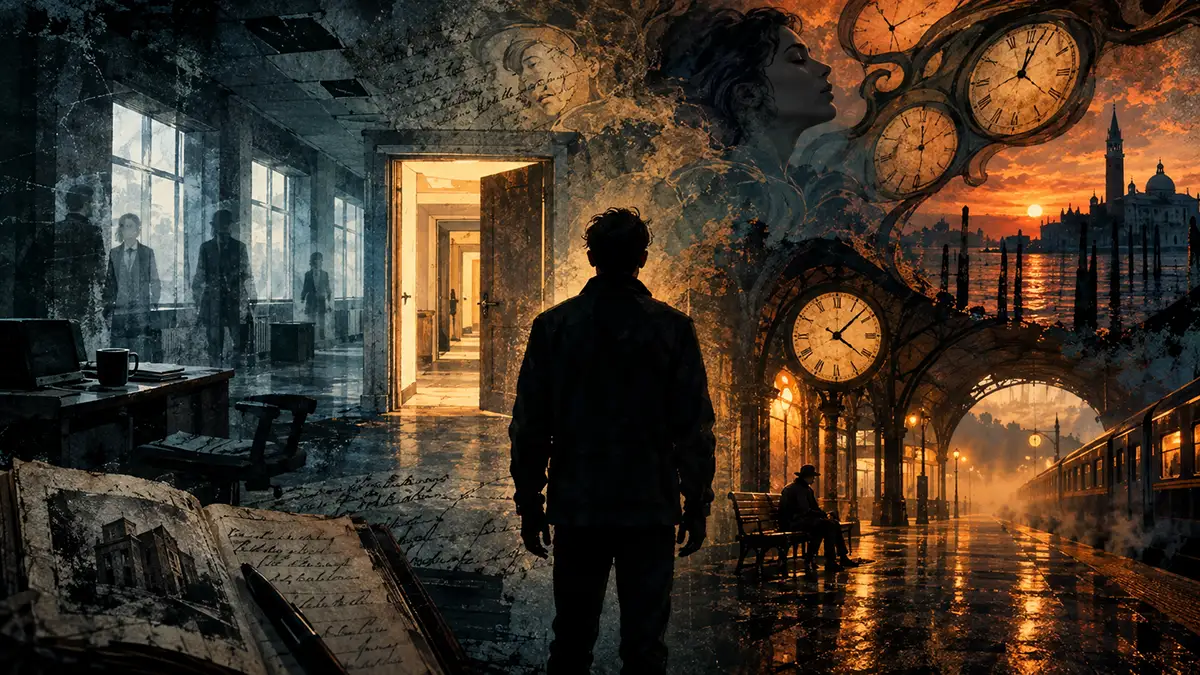
When Places Remember Us: Memory, Dreams and Liminal Spaces in Fiction
There are places we visit that seem to leave something behind in us. Sometimes it's a feeling of happiness, sometimes sadness, and occasionally something much harder to explain. We might return years later to find that almost everything has changed, yet something about the place remains strangely familiar.
I've often wondered whether places can somehow retain the presence of the people who once occupied them. Not necessarily in a supernatural sense, but through the memories we associate with them. An empty room can feel remarkably crowded when you remember the people who used to be there.
Perhaps the unsettling thing about certain places isn't their emptiness at all. Perhaps it's what our minds choose to fill that emptiness with.
Not All Liminal Spaces Are Unsettling
Liminal spaces are often portrayed as eerie, abandoned environments. Empty corridors, deserted shopping centres, silent office buildings and railway platforms without passengers. Photographs of these places can create an uncomfortable sensation, as though something is missing or the world has temporarily stopped behaving as it should.
But I've never found every liminal space disturbing.
A railway waiting room, for example, can be quite comforting. For me, it often represents the beginning of a journey, the anticipation of arriving somewhere new, or perhaps returning somewhere familiar. There's something reassuring about sitting quietly between departure and arrival, knowing that you're on your way.
Someone else might find exactly the same waiting room lonely or depressing.
The physical environment hasn't changed. Only the memories and expectations we bring into it.
I think that's an important distinction. A place doesn't necessarily possess an emotional character of its own. Much of that character comes from us.
The People Who Are No Longer There
Some time ago, I photographed an empty office building that had undergone renovation. I'd known the building before the work was carried out, and I'd also known some of the people who worked there.
The renovated interior was immaculate. Polished floors, white walls and empty rooms. Everything looked clean and orderly, yet the experience was strangely uncomfortable.
What I hadn't anticipated was how strongly I would remember the building as it had been.
As I walked through the empty rooms, memories of the people who once occupied them seemed almost superimposed over what I was seeing. I knew they weren't there, of course, but their absence was somehow tangible.
It was as though two different versions of the same building existed simultaneously: the physical space in front of me and the remembered space that continued to exist in my mind.
I found myself reluctant to leave, despite feeling uncomfortable. Outside the windows, the ordinary world looked warm and inviting, yet strangely distant.
When I finally stepped outside, I experienced an unexpected sense of relief. It was almost like waking from a dream.
I've written previously about that photographic experience, but what continues to interest me is not simply the appearance of the building. It's the way memory seemed to transform an otherwise ordinary environment.
Perhaps we never experience a familiar place entirely as it exists in the present. We also experience the versions of it that we've carried with us.
When a Place Becomes a Home
This relationship between memory and place is something I've become increasingly interested in through fiction.
One book that particularly stayed with me was Piranesi by Susanna Clarke.
Its central character inhabits an extraordinary House filled with vast halls, statues, staircases and tidal waters. To an outsider, the environment might seem bewildering, perhaps even frightening. Yet Piranesi develops an almost childlike affection for it.
The House is not simply somewhere he exists. It becomes part of his identity.
What I found particularly moving was that even after discovering something of his former life, he never entirely abandoned his attachment to the House.
I think there's something recognisably human about that.
We don't always develop affection for places because they're comfortable, beautiful or even safe. Sometimes our attachment grows from familiarity itself. A place becomes part of our personal history, and leaving it can feel like leaving part of ourselves behind.
Perhaps this is why some environments that appear unsettling to others can feel strangely comforting to us.
They contain something of who we are, or perhaps who we once were.
When the Impossible Becomes Ordinary
I'm currently reading The Unconsoled by Kazuo Ishiguro, and it explores another aspect of this fascination.
The novel follows Ryder, a pianist who arrives in an unfamiliar city, where seemingly ordinary situations become increasingly difficult to reconcile with everyday reality.
What interests me most is not simply the strangeness of the events, but how naturally the characters seem to accept them.
Ryder might enter a room he apparently doesn't remember, only for memories to suddenly return. Conversations and encounters interrupt one another, and people who seemed important moments earlier can be left behind as the narrative moves elsewhere.
At one point, Ryder is watching a film with Sophie when he's distracted by other people. The narrative follows that distraction, leaving the previous situation strangely unresolved.
Something similar happens when he's with Boris in a café.
In an ordinary story, these moments might demand an explanation. Here, they simply happen.
I find that far more unsettling than an obviously frightening event.
It's remarkably close to the logic of dreams, where impossible transitions and contradictions rarely trouble us while we're experiencing them. We accept a situation as perfectly normal, only recognising its absurdity after waking.
In fiction, this creates a peculiar uncertainty. We recognise the familiar details of everyday life, but the connections between them no longer behave as expected.
And perhaps that's what makes such stories so compelling. The world is recognisable enough to believe in, but never quite stable enough to trust.
Memories of Things That May Never Have Happened
The idea of memories that don't quite belong to our waking lives has fascinated me for years.
Occasionally, I experience a feeling of having been somewhere before, although I can't be certain whether the familiarity comes from a real experience or something I've dreamed.
It's an uncomfortable uncertainty because the memory itself can feel perfectly convincing.
The dream that eventually inspired my novel Dreams Don't Always End was remarkable precisely because so little about it initially seemed remarkable.
I was at work, watching the clock on the wall. At exactly five o'clock, I left, got into my car and began the drive home through the drizzle.
It was an ordinary, rather drab sequence of events.
There was nothing immediately fantastical about it. No impossible landscapes or extraordinary occurrences to announce that I was dreaming.
And yet the experience remained with me with the quality of an actual memory.
Sometimes I wonder whether that is what makes certain dreams so disturbing. Not their strangeness, but their apparent normality.
A dream doesn't always feel like something imagined. Occasionally it feels like something remembered.
When writing Dreams Don't Always End, I wanted to preserve that uncertainty. I wanted the boundary between waking and dreaming to become so thin that readers might believe they understood which side they were on, while retaining a lingering doubt.
Not necessarily whether the character is dreaming, but whether the reality they're experiencing is quite what it appears to be.
The Strange Attraction of Unsettling Places
One thing I've noticed about my own experiences is that discomfort doesn't necessarily make me want to escape.
In that empty office, I was reluctant to leave. The environment felt wrong, yet I was drawn to remain there.
Perhaps I was trying to reconcile the place I remembered with the one standing before me. Perhaps I simply wanted to understand why an ordinary building had produced such an unusual emotional response.
I don't really know.
But I think a similar attraction exists in the fiction I enjoy reading and the stories I want to write.
I'm drawn to environments where something is subtly out of place, where the ordinary becomes unfamiliar without ever becoming entirely unrecognisable.
An endless corridor is unsettling not necessarily because something frightening might be waiting at the end, but because I don't know whether it has an end at all.
More disturbing still is the feeling that I've walked along that corridor before, without being able to remember when.
There's something compelling about that uncertainty. It encourages us to continue exploring, even when we suspect we might be better off turning back.
Do Places Remember Us, or Do We Remember Them?
Perhaps the phrase a place remembers us is simply a poetic way of describing our attachment to familiar environments.
Buildings don't remember the people who lived or worked within them, at least not in any literal sense.
But we do.
We carry fragments of places with us: the sound of a particular room, the quality of light through a window, the atmosphere of a railway station, or the people we associate with a building that no longer looks the same.
Sometimes those memories are comforting. Sometimes they're painful. Occasionally they're so indistinct that we can't even be certain where they originated.
And perhaps that's why liminal spaces can affect us so differently.
Their emptiness leaves room for our own memories, expectations and imaginings to take shape.
A deserted waiting room might suggest loneliness to one person and the excitement of a journey to another. An empty office might be nothing more than a renovated building, or it might seem populated by the echoes of people who are no longer there.
The space itself is simply a space.
What makes it meaningful, comforting or unsettling is what we bring into it.
And sometimes, when a place feels strangely familiar, I find myself wondering whether I'm remembering somewhere I've actually been, somewhere I've visited in a dream, or somewhere that exists only in the uncertain territory between the two.