
Déjà Vu: Why Does the Impossible Feel So Familiar?
"Have you ever been somewhere for the first time, yet felt absolutely certain you've stood there before?"
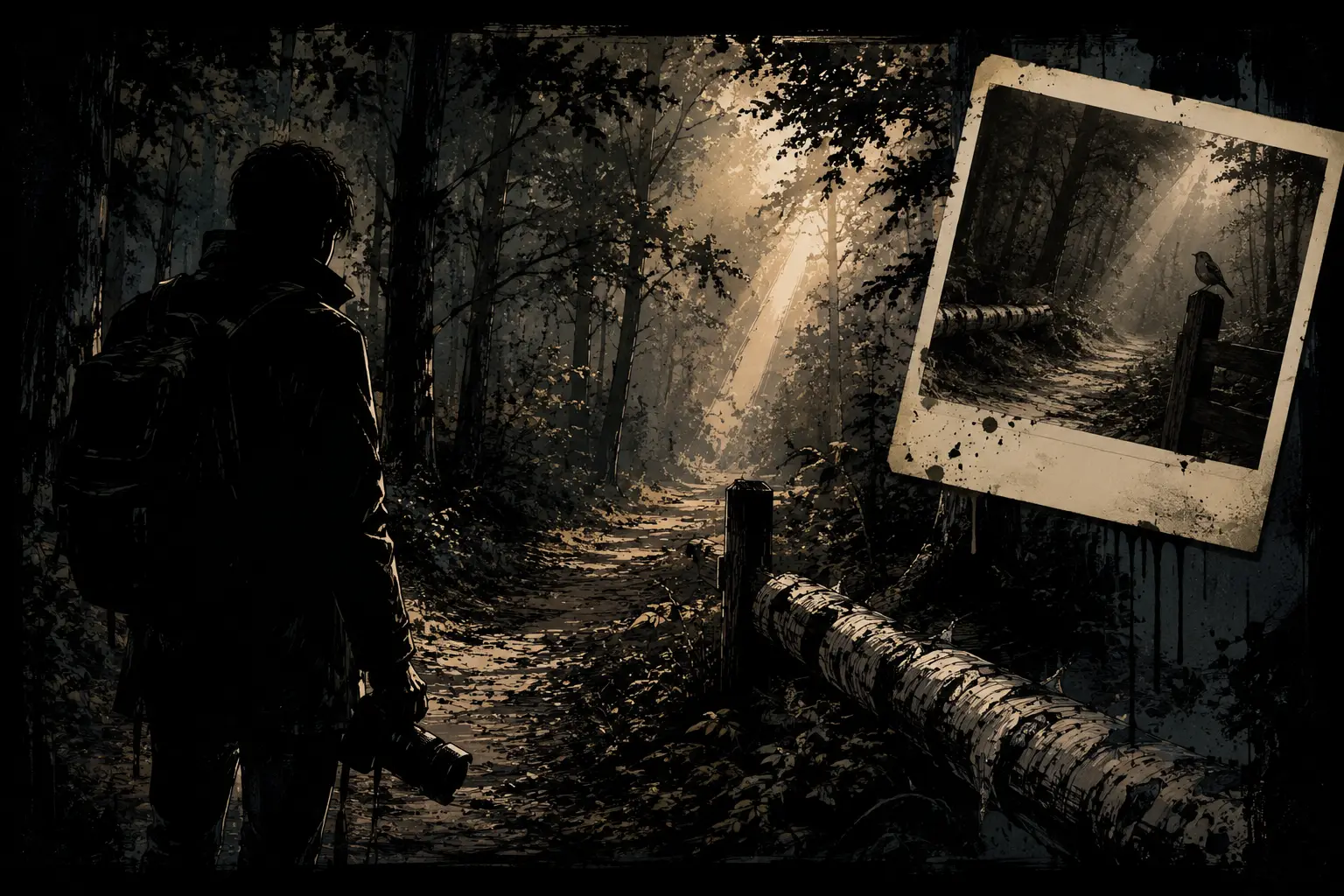
The woodland path stretched ahead, winding between moss-covered banks and old oak trees.
A photographer stopped walking.
Nothing about the scene was remarkable. The morning light filtered through the leaves in broken shafts. A fallen birch lay across the edge of the path. Somewhere in the distance a wood pigeon called.
Yet he knew what came next.
Not hoped.
Not imagined.
Knew.
A robin would land on the broken fence post.
He would raise his camera.
The sunlight would catch the bird's breast for a fraction of a second.
He could almost see the finished photograph.
Except none of it happened.
No robin appeared.
No photograph was taken.
Yet the certainty lingered.
How can your mind be so convinced of something that never happened?
We've All Been There
Most people experience déjà vu at least once in their lives.
It usually lasts only a few seconds.
Long enough to make us stop.
Long enough to question ourselves.
Then, almost as quickly as it arrived, it's gone.
What remains is confusion.
And curiosity.
It doesn't feel like remembering.
It feels like recognition.
Those two things sound similar.
I don't think they are.
The Brain's Explanation
Scientists have spent decades studying déjà vu.
Several theories have emerged.
Perhaps the most widely accepted involves memory processing.
Your brain may accidentally process new information as though it has already been stored as a memory. For a fleeting moment, the present is tagged as the past.
Another possibility is delayed perception.
Information reaches one part of the brain milliseconds before another, creating the illusion that you're experiencing something twice.
There are other theories too, involving familiarity networks and temporal lobe activity.
None of these explanations are unreasonable.
In fact, one or more of them may eventually prove to explain the phenomenon completely.
If that's the case, I'd happily accept it.
But...
Why Does It Feel So Convincing?
This is the question that interests me.
Not why it happens.
Why it feels so utterly real.
Think back to the strongest episode of déjà vu you've experienced.
For those few seconds, did you wonder whether it was real?
Or did you simply know it was?
The certainty arrives before the doubt.
Logic only catches up afterwards.
Memory Isn't Quite What We Think
We often imagine memory as a filing cabinet.
Open the drawer.
Retrieve the event.
Close the drawer.
Neuroscience paints a different picture.
Memory appears to be reconstructive.
Each recollection is, to some degree, rebuilt rather than replayed.
That alone makes me wonder.
How much of our confidence comes from memory itself?
And how much comes from the stories our brains tell us afterwards?
A Thought Experiment
Let's imagine something that almost certainly isn't true.
Imagine there are countless versions of reality.
In one world you left the house five minutes earlier.
In another you chose a different footpath.
In another you stopped to photograph a flower.
Most of those realities would never know about one another.
But suppose—just suppose—that for a fraction of a second they brushed against each other.
What would that feel like?
Perhaps it would feel like standing on a woodland path, convinced you've already seen the robin that never arrives.
Is that what déjà vu is?
Probably not.
But I find the question far more interesting than the answer.
The Photographer's Eye
Perhaps photographers notice these moments more than most.
Photography teaches us to slow down.
To notice tiny changes in light.
To remember places.
To compare one visit with another.
Sometimes I wonder whether photographers spend so much time observing the world that they also become more aware of the strange moments when it doesn't quite seem to fit together.
Not because the world has changed.
But because perception has.
Dreams That Feel Familiar
There's another question I've never completely answered.
Do I really have recurring dreams?
Or do I simply believe I do?
Certain places seem familiar.
Certain feelings return.
Certain people appear again and again.
Yet when I try to recall the dreams, they're never quite identical.
Perhaps the repetition isn't in the dream itself.
Perhaps it's in the emotion.
Or perhaps the brain is doing exactly what it does during déjà vu—creating an overwhelming sense of familiarity without providing the evidence to support it.
Living With Questions
One of the things I enjoy most about experiences like déjà vu is that they remind us how little we still understand about consciousness.
Science has explained extraordinary things over the last century, and I have no doubt our understanding of the brain will continue to improve.
But curiosity doesn't have to disappear simply because science is making progress.
The two can exist side by side.
It's perfectly reasonable to accept the scientific explanations while still finding the mystery captivating.
The Next Time It Happens
The next time you experience déjà vu, don't rush to explain it away.
Just notice it.
Notice how convincing it feels.
Notice how quickly certainty becomes uncertainty.
Notice how, within seconds, you're left wondering whether anything unusual happened at all.
Perhaps it was nothing more than a small glitch in the way your brain processed the moment.
Perhaps one day neuroscience will explain every detail.
Or perhaps experiences like déjà vu will always retain a small corner of mystery—not because they are supernatural, but because human consciousness remains one of the least understood frontiers of science.
Whatever the answer, I suspect the feeling will continue to fascinate us for generations.
And perhaps that's enough.