
Fragments: The Blood Collector
The following is an extract from a novel I am currently writing.
It is set in a reality that feels almost familiar, yet somehow different. Whether it is another reality or simply the one the narrator has always known is left for the reader to decide.
The first time I saw him it was winter.
He walked across the runway with his hands buried in the pockets of a heavy coat, the kind of coat people wear when they know they'll be outside all day. His face was framed by a dark blue knitted balaclava, open around the eyes and mouth. At the time I didn't think anything of it. Plenty of people dressed that way when the wind came in across the concrete.
I remember recognising him before I realised why.
He nodded as he passed, smiled politely, and disappeared between stacks of weathered wooden crates without saying a word.
I watched him for a moment before carrying on with whatever it was I had been doing.
Months later I saw him again.
Summer had transformed everything.
The air shimmered above the runway. Dust drifted across the concrete whenever a vehicle passed. Large wooden crates stood in untidy rows, as though they had been unloaded weeks before and simply left where they were. People crossed between buildings carrying paperwork, pushing trolleys and moving equipment. Nobody hurried, yet everyone seemed to have somewhere to be.
The aircraft was still there.
I don't remember anything about it except the tail.
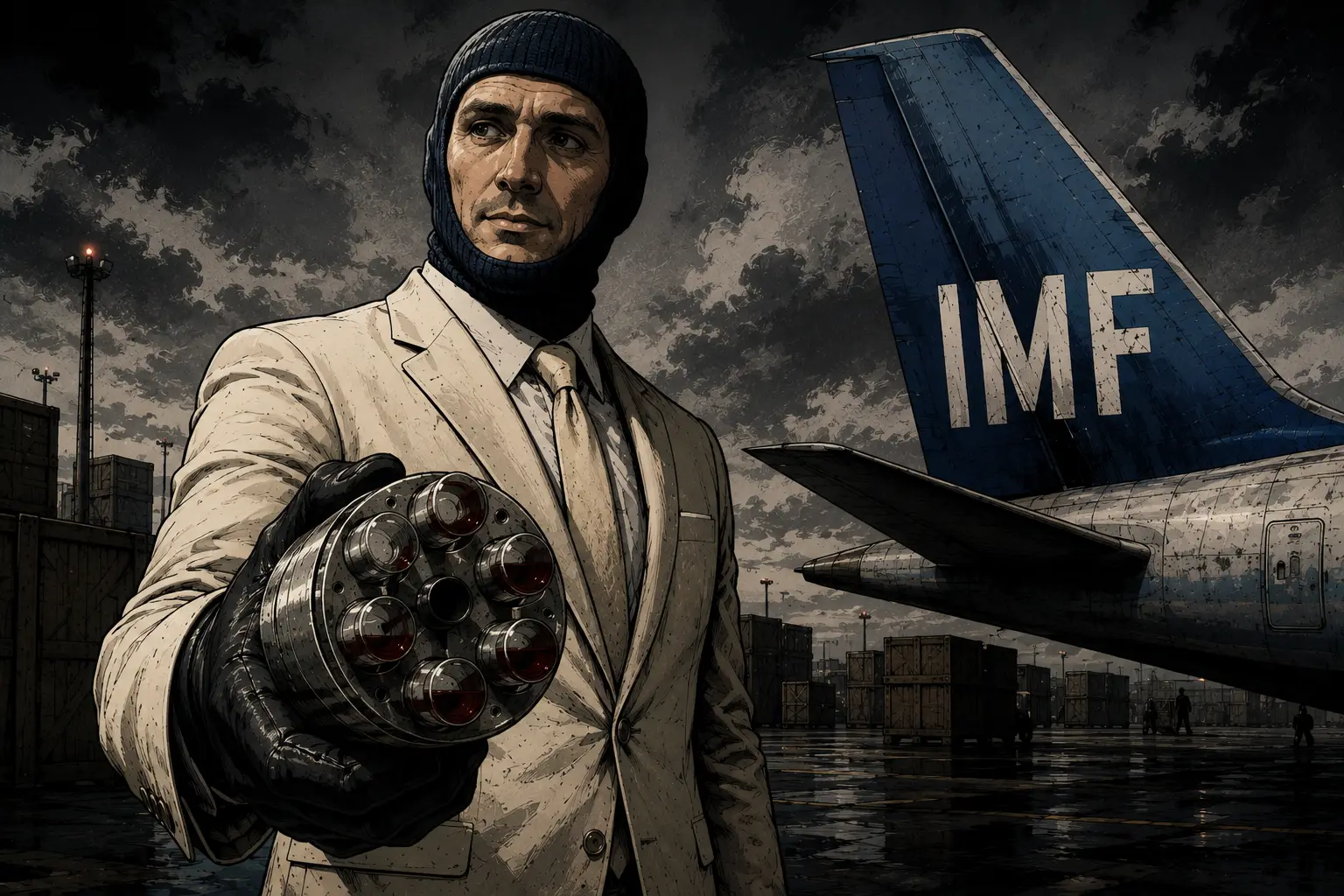
It was painted blue with three large white letters.
IMF.
I never questioned what they stood for.
Nobody ever did.
The man looked completely different this time.
The heavy coat had gone, replaced by a cream-coloured suit that looked almost too smart for the dust and heat.
The balaclava remained.
Looking back, it should have appeared ridiculous.
It didn't.
It simply belonged.
He carried a polished metal cylinder about the size of the barrel from an old revolver. Instead of chambers for bullets, each opening held a small glass vial that caught the sunlight as he walked.
He smiled when he reached me.
He had the sort of face people trusted immediately. Soft features. Gentle eyes. The easy smile of someone who had repeated the same conversation thousands of times before.
"Morning," he said.
I held out my arm.
He removed one of the empty vials, fitted it into the cylinder and took the sample with the practised ease of someone who had done it thousands of times before.
When he had finished, he returned the now-dark vial to the cylinder, thanked me with a nod and continued along the runway.
Nobody looked up.
Nobody waited their turn.
Nobody objected.
People simply carried on with whatever they were doing.
Within minutes he had disappeared into the movement of people crossing the runway, the blue tail of the aircraft standing silently behind them.
I never saw where he went.
I never wondered where the blood was taken.
At the time, there seemed no reason to ask.