
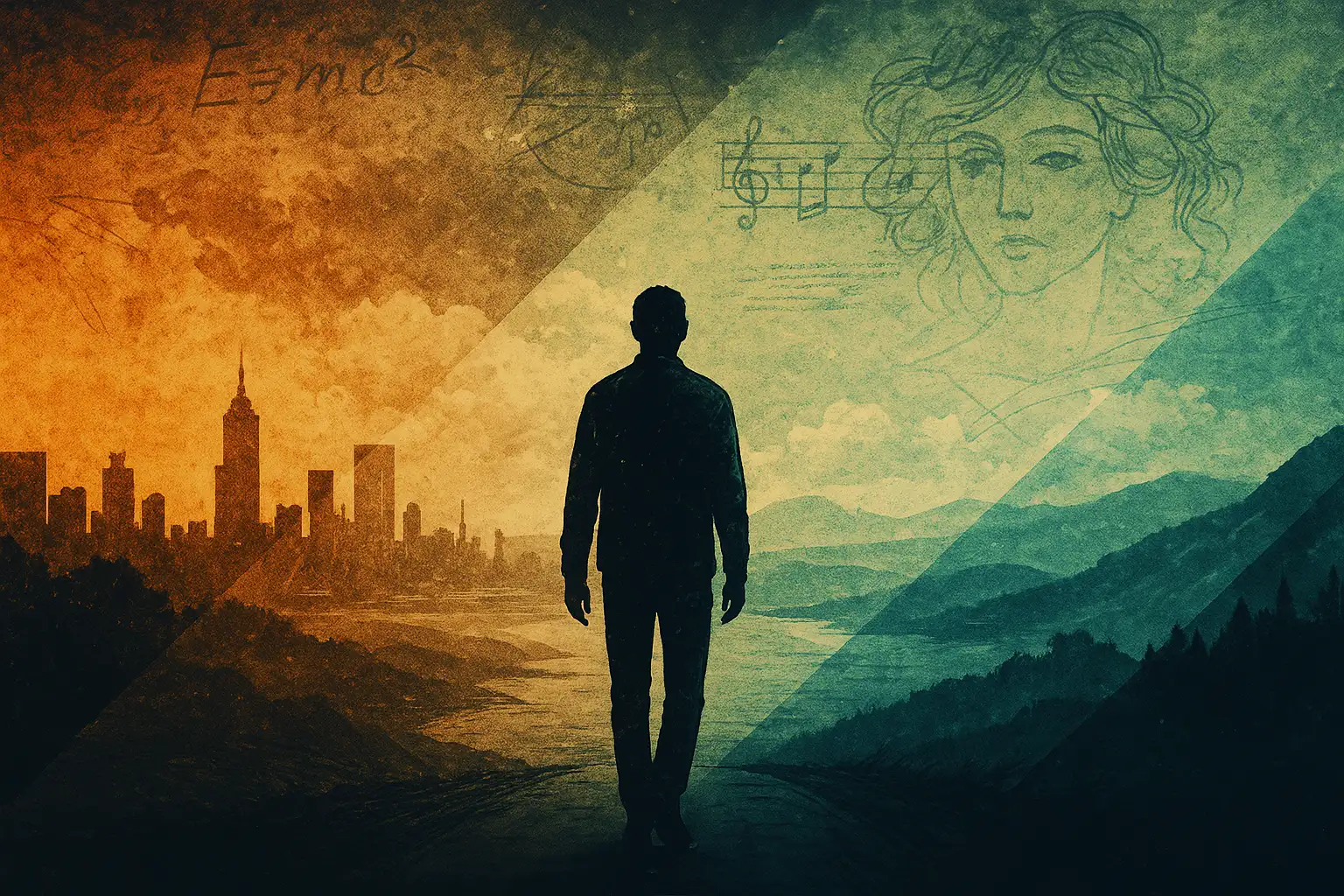
Novels About Dreams and Reality: How Night Visions Shape Creativity
Dreams have always fascinated us. We wake with fragments still clinging to us—a sound, a place, a feeling we can’t name—and wonder where they come from, or what they’re trying to say.
Across history, dreams have guided some of humanity’s greatest leaps in art, science, and understanding. They’ve inspired music, painting, literature, and even scientific discoveries that changed the way we see the universe.
It’s no surprise, then, that novels about dreams and reality resonate so deeply. They speak to something ancient in us: the sense that the boundary between waking and dreaming isn’t as solid as we pretend.
My own book, Dreams Don’t Always End, was born from this space. But before I explain how, let’s explore the curious, often surprising ways dreams have shaped creativity across time.
When Dreams Guide Discovery
Some of humanity’s most groundbreaking insights came not from hours of careful reasoning, but from a vision in the night.
Dmitri Mendeleev — The Russian chemist struggled for weeks to organise the known elements. Then, after falling asleep at his desk, he dreamed of the entire periodic table arranged perfectly. He woke, sketched it down, and it proved correct.
Otto Loewi — Winner of the 1936 Nobel Prize, Loewi dreamed of an experiment involving frog hearts that revealed how nerves transmit signals chemically. He woke in the night, scribbled it down, and by morning had changed neuroscience forever.
Elias Howe — Inventor of the modern sewing machine, Howe spent months trying to solve the problem of the needle design. In a dream, he imagined being chased by warriors carrying spears with holes near their tips. He woke, understood the mechanism, and built a working prototype.
Dreams don’t just replay memory—they open doors to insights we might never reach consciously.
Dreams in Art and Literature
The relationship between dreams and creativity goes back centuries.
Dmitri Mendeleev and the Periodic Table
The story goes that Dmitri Mendeleev, exhausted from weeks of work on chemical classification, fell asleep at his desk. In a dream, the elements “fell into place as required” on a table he’d been struggling to perfect.
The truth is more nuanced. Mendeleev had already spent years studying the elements, and the breakthrough didn’t come out of nowhere. But the dream acted like a final spark, allowing his subconscious to arrange what his conscious mind had been chasing.
Sometimes dreams don’t invent new worlds — they help us see the patterns already forming beneath the surface.
Mary Shelley and the Birth of Frankenstein
In 1816, during the infamous “year without a summer,” Mary Shelley stayed by Lake Geneva with Percy Shelley and Lord Byron. One night, Byron challenged the group to write ghost stories.
Mary struggled — until one night, half awake, she had a vision:
“I saw — with shut eyes, but acute mental vision — the pale student of unhallowed arts kneeling beside the thing he had put together.”
That image became the seed of Frankenstein. Shelley didn’t dream the entire story, but in that half-conscious moment, the spark arrived.
Paul McCartney and Yesterday
Paul McCartney famously dreamed the melody for Yesterday, one of The Beatles’ most enduring songs. He woke with the tune fully formed in his head and rushed to the piano to play it out before it slipped away.
At first, he thought it couldn’t be original — he played it to friends and fellow musicians, convinced he must have stolen it. But when no one recognised it, he knew it was his.
Sometimes, dreams don’t hand us answers; they simply deliver what we already know, hidden deep inside.
Dreams Don’t Always End: A Personal Journey
For me, Dreams Don’t Always End began the same way many discoveries do: with a recurring dream.
I kept seeing the same moment — a motorway crash involving a Luton van on the M4. The sensation of time slowing, the sounds folding in on themselves. It wasn’t just vivid; it carried weight, like there was something beneath it I didn’t understand.
At first, I ignored it. But the dream returned. And over time, I realised I wasn’t just being haunted by an image — I was being invited to explore what it meant.
The novel emerged slowly, shaped by memory, regret, and possibility. The settings — the flat where time stood still, the endless corridor, the X-ray waiting room — each became symbolic spaces where reality bent and shifted.
Writing it felt less like constructing a story and more like uncovering one. Sometimes, I felt guided by something beyond conscious thought — the same way Mendeleev or Shelley described their experiences.
That’s why I believe novels like mine resonate with readers who seek something deeper. They’re not just about dreams. They’re about the way dreaming changes us.
📖 Step inside the dream →
Why We Gravitate Toward Dreamlike Fiction
We read dream-infused novels because they mirror our own uncertainty about what’s real and what’s imagined. They explore questions we’ve all felt, even if we’ve never put them into words:
Do our choices create alternate versions of us?
Are our dreams messages, or just noise from a busy brain?
Can time fold back on itself in ways we can’t perceive?
What if memory isn’t just the past, but a doorway?
When reality feels uncertain — when we sense that something deeper flows beneath the surface — these stories give shape to feelings we can’t explain.
Dreams, Memory, and Meaning
In writing Dreams Don’t Always End, I realised something: dreams and memory are intertwined.
Just as dreams fold time and place together, memory reshapes itself every time we revisit it. That’s why certain moments linger — not as they happened, but as they felt.
Dreamlike novels explore this beautifully. They create spaces where characters encounter other versions of themselves, where timelines double back, where meaning hides in silence. They give us permission to ask “what if?” and to sit with the answers, however incomplete.
A Tradition That Keeps Growing
From Mendeleev’s periodic table to Dalí’s dreamscapes, human creativity has always been shaped by the strange power of dreams. In literature, too, we keep returning to this theme, again and again, because we recognise ourselves in it.
Dreams Don’t Always End is part of that tradition. It doesn’t try to solve the mystery; it invites you to live inside it for a while. To walk through symbolic spaces where dreams and waking life bleed into each other, and where nothing is quite as it seems.
📖 Discover the book → [Buy Now Button]
Final Thoughts
Dreams are fleeting, fragile things — but sometimes, they leave us changed.
They’ve given us inventions, art, music, and stories that redefine what we know. And for many of us, they remain private maps to unexplored parts of ourselves.
That’s why novels about dreams and reality matter. They remind us that truth isn’t always linear, that meaning can live in fragments, and that sometimes the most important journeys begin while we’re asleep.
If you’ve ever woken from a dream you couldn’t shake, if you’ve felt reality ripple beneath your feet, or if you’re drawn to stories where memory and meaning intertwine — Dreams Don’t Always End might just speak to you.
📖 Step inside the dream →